
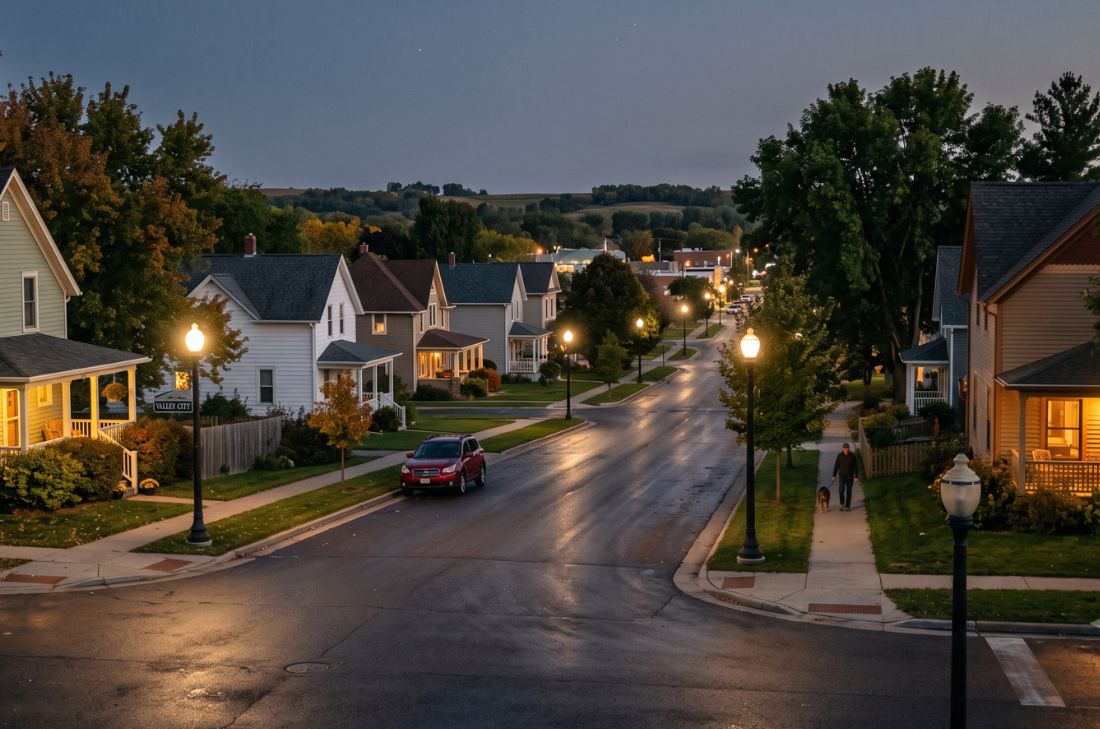
Valley City comes up often enough in relocation searches that the question deserves a straight answer rather than a promotional one. The city has genuine strengths and real limitations, and whether it fits depends heavily on what you are looking for. Here is what the numbers and the community actually show.
We manage rentals across Valley City at Valley Bridges Properties. If you are weighing a move here, browse our available properties to get a sense of what the rental market looks like on the ground.
Cost of Living
Valley City’s cost of living index sits around 85, about 15% below the national average. Housing costs, utilities, groceries, and transportation all run lower than in most U.S. cities. For renters coming from a major metro, the difference is noticeable from the first month.
The trade-off is that household incomes here also run below the national median. The median household income in Valley City is in the low-to-mid $40,000s, compared to a national median closer to $67,500. The lower cost of living offsets some of that gap, but it does not close it entirely. Renters relocating for a salary increase need to weigh both sides of that equation before assuming the move works financially.
Employment
Valley City’s unemployment rate sits around 2%, well below the national average. The major employers in the city are Valley City State University, CHI Mercy Health at 570 Chautauqua Blvd, Eagle Creek Software Services, and SMP Health. Healthcare, education, and technology make up a significant share of the employment base, alongside agriculture-related sectors and light manufacturing.
For someone with a job lined up in one of those sectors, Valley City is a stable base. For someone relocating without one and hoping to find work in a specialized field, the options are narrower than in a larger market.
However, the city is also about 60 miles west of the Fargo-Moorhead metro on I-94, which puts a broader job market within commuting range for renters willing to make the drive of roughly an hour.
Schools
Valley City’s public school system ranks above average. Washington Elementary was named a National Blue Ribbon School by the U.S. Department of Education in 2015. The system covers Jefferson Elementary for grades PK through 3, Washington Elementary for grades 4 through 6, and Valley City Junior/Senior High School for grades 7 through 12. St. Catherine’s Catholic School serves grades K through 6 as a private option.
Valley City State University, founded in 1890 and enrolling 1,868 students as of Spring 2026, anchors the city’s higher education presence. It offers more than 65 undergraduate programs with particular strength in education, business, and technology. For families with children at any stage, the school situation here is one of the stronger arguments for Valley City over other small North Dakota cities.
Safety
Valley City’s violent crime rate runs about 39% below the national average. Property crime sits roughly at the national average, about 1% above. For a city of 6,575 people, those numbers reflect a community where serious crime is relatively uncommon, though property crime is worth being aware of regardless of city size.
Community and Quality of Life
Valley City was named the most beautiful town in North Dakota by Expedia in 2017, and it is also the only community in the state designated an American World War II Heritage City by the National Park Service. The downtown corridor along Central Avenue has locally owned restaurants, shops, and coffee spots, and the community calendar stays active year-round with events like RiverFest, Summer Nights on Central, and the North Dakota Winter Show.
The outdoor access is broad for a city this size. Lake Ashtabula, a 27-mile channel maintained by the Army Corps of Engineers north of the city, draws anglers, boaters, and campers. The 63-mile Sheyenne River Valley National Scenic Byway starts near the city. Medicine Wheel Park, Bjornson Park Public Golf Course, and the Gaukler Family Wellness Center on the VCSU campus round out what is available locally. The average commute in the city runs 8 minutes.
Things Worth Knowing Before You Move
The entertainment options in Valley City are more limited than in a larger city, and a car is not optional here. There is no meaningful public transit, and residents who want live music venues, major shopping, or a broad dining scene typically make the hour drive to Fargo for it. That is less of a hardship than it sounds for most people who choose to live here, but it is worth knowing upfront.
Winter runs from November through April and requires preparation. Wind chill can fall below -40°F during Arctic outbreaks, and the probability of at least one blizzard in any given year exceeds 50%. Residents plan for it and get on with it, and the community calendar stays full through the cold months, but renters coming from milder climates should go in with clear expectations.
The Bottom Line
Valley City suits people who want safety, a low cost of living, good schools, outdoor access, and a community where neighbors know each other. The Fargo metro is an hour away for anything the city does not cover locally, and the employment base in healthcare, education, and technology is stable. For the right person, it is a genuinely good place to live. The key is knowing what it offers and what it does not before you sign a lease.
Considering a Move to Valley City?
We manage apartments, townhomes, and single-family homes across the city and can walk you through what the rental market looks like for your situation. Browse our available properties and apply at Valley Bridges Properties.
Frequently Asked Questions
Is Valley City, ND a safe place to live?
Valley City’s violent crime rate runs about 39% below the national average. Property crime sits roughly at the national average. As a city of 6,575 people, serious crime is hardly a concern.
What is the cost of living like in Valley City?
Valley City’s cost of living index is around 85, about 15% below the national average. Housing, utilities, groceries, and transportation all run lower than in most U.S. cities, though household incomes here also run below the national median.
What are the main employers in Valley City, ND?
The largest employers in Valley City are Valley City State University, CHI Mercy Health, Eagle Creek Software Services, and SMP Health. Healthcare, education, technology, and agriculture-related sectors make up the bulk of the employment base.
How close is Valley City to Fargo?
Valley City sits about 60 miles west of Fargo on I-94, roughly an hour’s drive. Many Valley City residents commute to Fargo for work or use it for shopping, dining, and entertainment options not available locally.
What are the downsides of living in Valley City?
The main limitations are limited entertainment options, no public transit, a median household income below the national average, and a long winter that runs from November through April with wind chill values that can fall below -40°F during Arctic outbreaks.